


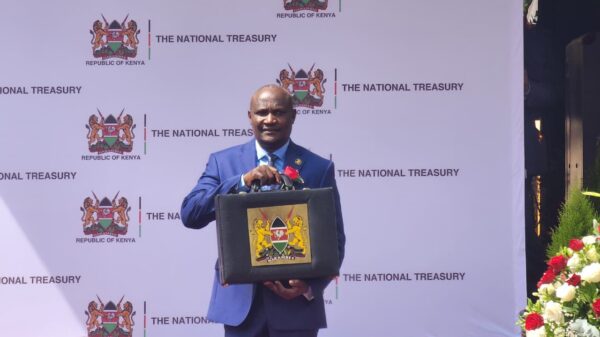



















NAIROBI, Kenya, Mar 19 – The government of President William Ruto aims to increase tax collection to Sh3 trillion in the fiscal year ending June 2024.
However, it faces a daunting task to collect the above amount amid leakages of taxes as well as under-declarations by numerous firms.
One area where the state could raise additional funds by sealing loopholes is the online space, whose popularity has been growing in the last few years.
Such areas include e-commerce, pay TV, and mobile money, among others.
To achieve this, it plans to work with companies that track tax evasion and loopholes.
Capital Business spoke to N-Soft, a company that helps governments track taxes, enabling nations to raise extra funds.
Here is a conversation with Prakash Sabunani, the firm’s Senior President & Partner:
Will President William Ruto’s administration be able to raise Sh3 trillion for the year ending June 2024, amid online tax cheats and under declarations
I’m aware that the Kenyan government has set a target of Sh3 trillion in the online space because they feel that the Sh2 trillion that was raised (last fiscal year) is not enough.
So basically, the last fiscal exercise generated Sh2 trillion in shillings for the Kenyan economy by the Kenya Revenue Authority (KRA), which made for basically a new record in the tax collection.
So expecting this to go up by 50 percent within a year is a little optimistic, to be honest, even if we are given the opportunity as a company at N-Soft to bring in our solutions and to contribute to this race in scaling tax collections.
But on the other hand, the targeted collection estimate is way beyond the cohesive tax GDP indicator because that is what we have to look at. This indicator has been dropping for a number of years in Kenya; it was at about 18 percent in 2016 and stands today at 14 percent, all this despite the newfound economic rebound in the countryars in Kenya; it was at about 18 percent in 2016 and stands today at 14 percent, all this despite the newfound economic rebound in the country. But despite that, the tax GDP indicator is only at 14 percent.
The economic growth is not really sustainable at this rate, despite a growing economy. But your productivity rate is slowing down. So economic growth needs to come from high productivity or income, which could then translate into increased taxes. But that’s not the case at the moment.
So to put the Sh3 trillion expectation into perspective, you would need a 20 percent tax to GDP ratio, which could then generate, by scaling economic growth, a ratio of about 20 percent within a year. That would be the best you could achieve, which even today is pretty much unrealistic in today’s global economic meltdown and high inflationary tendencies because this is what we’re going through and it’s not only in Western Europe or the US; it’s across the board and it’s across the world. So, the scalable models that have been set by the president are obviously a bit optimistic, and it’s going to be very difficult to jump from Sh2 trillion to Sh3 trillion within a year.
That is really pushing the scale a bit high. But as I said, if we come into the game, if, for instance, N-Soft is invited to help the KRA contribute towards this, our solution can most definitely contribute towards this given the nature of our economic transparency and strategic positioning.
But even then, it will be very difficult to scale up by 25 percent or 50 percent within a year. No single industry can carry that current.
Which sectors of the digital economy are prone to tax evasion?
So there are several sectors given the obvious change derived from the post-pandemic era where digitalization has been pushed to new heights and inclusiveness within the local economy and consumer base.
In this, you have digital advertising like the likes of Meta, which is Facebook, Google, YouTube, TikTok, all the digital contributors today that have a very essential role in the consumer’s life and in the daily economic flow of the different sectors of industry.
As a result, digital advertising is a major source of revenue for these large advertising firms that generate all of this data online.
And then you also have gaming and the gambling industry, which are also major contributors. You have, of course, mobile and other forms of digital banking and monetization, which are also very important. And these are all daily use cases: currency exchange for virtual platforms, digital TV, video, on-demand, pay TV, and other forms of digital entertainment.
All these industry segments are essential contributors to the digital economy, and these are sectors that are highly protected simply because the government doesn’t have the right tools and the KRA doesn’t have the right tools to verify, consolidate, supervise, and monitor.
So for them to really enhance the collections from these sectors of the additional economy, they would have to change a lot of their methods and their ways of having the correct data at hand.
Briefly tell us about N-Soft and some of the solutions that you offer
Basically, what we do is adapt our solutions to the requirements of the government and the revenue department. So we first have to understand the need for the revenue services, like what is needed on the ground and what is the best way moving forward to really generate quick results for the tax collection and how.
We have a solution for the mobile banking segment, which in Kenya is very, very large. I mean, an operator like Safaricom, for instance, generates 90 percent of its revenue through mobile banking. Yes, that turnover is very, very big in that segment. So, we have a solution for that.
We have a solution for digital advertising, gaming and gambling, and pay TV. So, it really depends on which segment of the industry we’re actually targeting.
We come with a very holistic solution that helps them really analyze and recover the chosen sector of the industry that they really want to target. And we not only give them a solution; we also help them implement, deploy, train, and do skill transfer for their engineers and technicians to really understand how the solution over time can really enhance their revenue and give them better visibility and transparency in the tax collection.
Please tell us about the payment plan on the solutions
There’s no flat rate. It all depends on the volumes we have to work with and the perimeter we have to cover. This is something that we have to work with the client and the government on based on what exactly their target is and their capacity, and then we adapt our solution based on that.
So, we could work within a partnership framework with the government; we could work as a service provider; we could work as a vendor. The models are very vast. We don’t have a one-stop solution. For us, it’s an adaptable solution based on the requirements of the government.
In which countries have you deployed your solution in Africa
We have deployed in many countries in West Africa, East Africa, and North Africa.
Few governments depend on our solutions to collect and optimize data, because that’s very important.
You see, optimizing data is one thing; collecting revenue is another. So, our role here is to give the government the correct data that they need to be able to then understand how they’re going to collect what is theirs.
But as I told you, we do not collect the money; we just help them get the right figures and the right visibility and transparency to know what is missing in their monthly collections or their daily collections.
Consequently, are you planning to expand to Kenya. What is the timeframe.
We are in discussion with the Kenyan government at the moment, but we have not been able to (go very far).
I think the KRA is very busy trying to see how they can meet the requirements of President Ruto, and they’re trying to find ways to hit the targets, but it’s going to be very difficult for them if they don’t have the right tools.
And even if we come with our tools, we cannot guarantee that we can generate an extra Sh1 trillion within a year. It’s very difficult because we have a lot of constraints. You have to understand the countries implementing such solutions require a lot of transparency and a legal framework because, in most cases, the digital economy, advertising, and pay TV are all regulated by rules and laws imposed by other regulators of each of the industries.
So, how does the system operate
We have a centralized data collection point where we put in all the data that transits on the network of each of these operators, and we centralize all the billing, all that goes into the billing.
So each billing step is captured by our systems, translated, analyzed, and then given to the carriers for their daily real-time supervision tool.
And they can see on a real-time basis what each transaction is for each of the network operators involved in that part of the industry.