










By Phyllis Nyambura
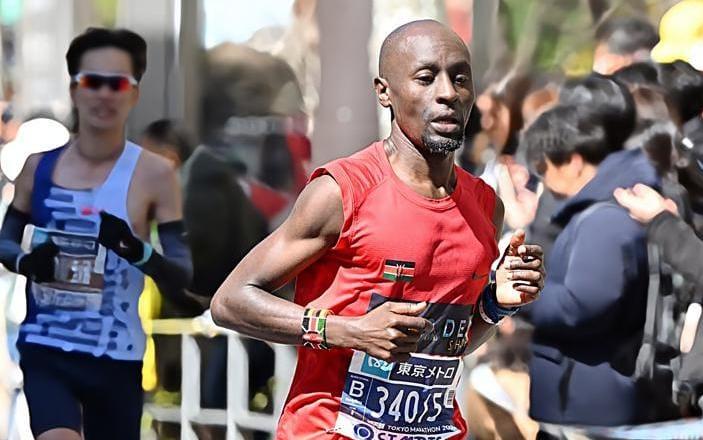
NAIROBI, Kenya, Mar 7 – The first thing you learn about Isaac Mwabago is that he’s a man who does not do half-measures. He’s pursuing his PhD while having run 24 marathons and two ultra-marathons across the globe—a pursuit that started to ward off Covid-19 boredom.
In 2017, the lifelong sportsman who has played badminton, tennis and squash for the national team quit his banking career to pursue business, armed with a resolve to provide quality, genuine sports merchandise.
The passion had started in 2011, when a fellow student introduced him to selling sports shoes online.
“He had bought the shoe from Gikomba, and it cost Sh1,200, which was quite pricey to me then,” says Isaac, who had first picked up a racket in high school.
Still involved in sports while working at the bank, he wondered if he could supply kits for the interbank games.
“They told me I had to go through a lengthy process to become a supplier,” he says.
In the next few months, he registered his company and quit his job. By 2018, he secured a Malaysian manufacturer specialising in racket games and became their official supplier.
He opened a physical shop in 2022, and soon after, got into the supplier list at Absa. Today, he supplies more than seven banks across Kenya, elite customers and the government.
The second thing you need to learn about the founder of Badeq Sports House is that discipline drives him.
He applies three ethos from his sporting and banking career: high standards, time management and consistency.
Every day, he wakes up at 3am and runs 20-40km. By 6-7am, he is in his shop on Tom Mboya Street, Diamond Shopping Mall, opening the doors by 8am to serve customers and do inventory until 5pm. He posts content on social media four times a day, and by 5.30pm, is in his PhD class.
He then proceeds to the gym, has a badminton session before heading home to Tala, Machakos, ‘a place he finds peace’, by 11pm. He’s asleep by 1 am.
This military precision transfers to his staff, where everyone is resolute that if you report a minute after 8am, you go back home.
“Not as a punishment but because lateness creates permanent catch-up. Think: If you arrive just a minute late to a race, you will not win,” he says, adding that even in the bank, vaults have to be opened at a particular time, without fail, otherwise there will be a crisis.
To ensure everything works in tandem, Isaac invests in a workable system.
“Systems back everything: stock, sales, social media posting and accountability. There is no coincidence in life, only systems.”
When it comes to consistency, the 35-year-old father of one, strives for perfection.
“If you repeat something for 21 days, it becomes your character,” he says. “I just want things done the right way.”
The third thing you note of Isaac is that he is unyielding and sees the glass as always half full. His mantra: ‘If you can finish a full marathon, nothing else in life can break you.’ To test his resilience, an opportunity arose to meet his hero, Eliud Kipchoge, a few years, after the famed marathoner had smashed the INEOS 1:59 Challenge in 2019.
When the call came, he was delivering supplies along Waiyaki Way, Nairobi. “You can meet him if you are here by 6 am tomorrow,” the voice said. The meeting was in Eldoret, and the last flight was to leave Nairobi by 6pm. His clock showed 5.20pm.
“I will be there,” he assured the caller as he jumped on a boda boda to JKIA, making the booking and payment while on the ride. By 5.45pm, he was boarding the flight, and by 6am the next day, he was at the gym where Eliud Kipchoge and Faith Kipyegon practised.
“Young man, what can I do for you?” Eliud quizzed. Too star-struck, words failed Isaac.
“We had a gym session, he signed some merchandise for me, and a photo op,” he chuckles. It was the beginning of a friendship and mentorship he cherishes.
These resolutions have done his business well. In his eighth year, he is breaking even and scaling, challenging traditional elite sports house brands that have run for decades.
But ever so modest, he credits his achievements to the support of those he’s crossed paths with.
“My relationship with Absa (customer) is built on friendship. Our relationship started when I trained at their sports club. Then I became an employee. Today, they trust me to supply merchandise for their sporting events. They have opened doors to other banks and given me visibility which made others trust my products,” says Isaac.
At the 2024 Magical Kenya Open, Absa gave him one minute to speak. “That moment changed everything. The Sports CS visited our tent and saw our tracksuits, while the Absa MD, Abdi Mohamed was wearing one of them. The connection led to supplying non-Nike items for the Olympic team. Later that year he supplied kits most banks at the interbanks games,” he says.
Support is something he applies in his own life, sponsoring several upcoming sportspeople, including Kenya’s current badminton champion, Wilkie Keragori.
“I sponsor teams, including my community in Kisii. Many athletes are under my catalogue. At this year’s Sirikwa Cross Country Classic in Eldoret, I’m sponsoring four athletes with everything. I don’t know why I do it. I think it’s because I’m a product of people,” he says.
Like any business person, Isaac has drawn lessons from his failures. One such lesson came early in his career, in 2019, which taught him not to chew more than he can handle. Just before Covid-19, he got a major breakthrough: the National Africa Olympics qualifiers for the Deaf Games were being held at Kasarani, and the Ministry needed a supplier.
One night, around 1am, he received a call asking if he could bring samples. That call changed everything. They wanted 1,000 pairs of shoes and 1,000 tracksuits delivered in three days.
He was still operating from home with small quantities, but this opportunity demanded scale. The deal was worth close to Sh22 million.
He personally sank about Sh11 million, sourcing goods urgently from China and chartering a plane.
His brother, a junior doctor in Eldoret, redirected a loan meant for opening a veterinary business and sent it to him. The Ministry never honoured their payment.
“To date, that money has never been paid. I have the LPO. I even appeared before the Presidential committee on pending bills. Nothing changed,” he says. “I burnt myself,” he chuckles.
He survived because his brother gave him time, and he paid him back in bits over the years.
“I never really got out of that hole. I am technically still in it. But I have a sports background, and I later transitioned into athletics and marathon running. If you can finish a full marathon, nothing else in life can break you. So I kept paying debts in pieces — every profit, every boom, slowly.”
That episode strengthened his resolve. At the moment, he is keen to change the perception that quality is expensive.
“Sports business is unique. It’s seasonal, it evolves every day. Unless you have a thick skin and you are willing to stay long enough, you’ll be left with dead stock,” he cautions. To extend his shelf-life, he comes up with original Kenyan designs, donates and uses his marathon quest to draw visibility.
But he has one piece of advice for those wanting to enter business. “Just start. Post that product in a bad photo. Once you start, stay consistent.”
For now, he has his sights on opening up in uptown and also opening a sports complex. “I believe in, as long as you are doing the right thing, things will just work out,” he says.
He is currently preparing for the Boston or Cape Town Marathon slotted for April and May this year. “I recorded 2:21 in Dubai. I want to push it to two hours, 10 minutes.”
Will he ever slow down? “Never,” he declares.
What’s the end goal? “I don’t have an end goal. I’m just running. In the same way, I’m doing my PhD. I want to push the limits and prove that anything is doable. I just want to be a good person in this society.”
phyllisnyamburawork@gmail.com