
























JULY 11 – The US government is to become the biggest shareholder in the country’s only operational rare earths mine.
It is also going to take a series of other steps to underpin the future of the operation in Mountain Pass, California.
Rare earths are essential to huge amounts of modern technology, such as electric cars and wind turbines.
Access to these metals has been at the heart of a US-China trade war, with Beijing controlling about 90% of global mining capacity.
MP Materials, which owns the mine, has entered into an agreement with the US Department of Defense that is designed to reduce America’s dependency on imports of rare earths.
The deal means that for the next 10 years the US government will commit to MP Materials receiving a minimum price of $110 per kg for its neodymium and praseodymium output.
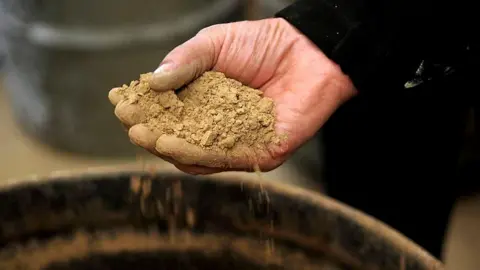
These are two of the most in-demand of the 17 different rare earths for the global economy. They are crucial for making permanent magnets, which are found in everything from smartphones to MRI scanners and electric motors.
The move follows concerns that China has used its near total control of the industry to push prices down and force companies in other countries out of business.
 Getty Images
China is home to about 70% of the world’s rare earth mining and 90% of refining capacity as a result of years of government support for the industry.
Under the agreement, MP Materials will build a new US facility to increase how much of the raw materials from the mine it can turn into useable products.
The location is still to be decided, but the company says it will serve both defence and commercial customers.
Much of this will be funded by the Department of Defense buying $400m of newly created shares.
“This initiative marks a decisive action by the Trump administration to accelerate American supply chain independence,” said MP Materials founder and chief executive James Litinsky.
Until now Shenghe Resources, a company partly owned by the Chinese government, has been one of MP Materials’ largest shareholders.
Shenghe had been the sole customer for the output of the Californian mine, which meant that its rare earths were being sent to China for refining.
Earlier this year, MP Materials said that it would stop doing this because of the huge 125% tariffs that China imposed on US goods, in response to the 145% tariffs President Trump had imposed on Chinese imports.
It added that tariffs meant sending its output to China was neither commercially viable nor in alignment with America’s national interests.
Trump delays tariffs as the rest of the world plays hardball
EU hopes to agree US tariff deal ‘in coming days’
Rare earths have been at the heart of efforts to repair a US-China trade relationship that has deteriorated since Trump returned to the White House.
Increased tariffs led Beijing to impose a new export licensing regime that severely limited how much of these materials was reaching American manufacturers.
An agreement to improve that access, in exchange for lifting some of the US’s own export restrictions in other areas, was at the heart of recent trade talks between the world’s two biggest economies in London and Geneva.
Despite that commitment the US complained that it has not been implemented fast enough.
In the longer term, domestic supplies are the US’s best bet on increasing access to the rare earths which are crucial to the manufacturing that is at the heart of Trump’s economic vision for the country.
China’s export controls have also led to criticism in Europe, with the European Parliament voting in favour of a resolution that called Beijing’s controls “unjustified” and “intended to be coercive”.
They also urged the European Commission to speed up the implementation of the Critical Raw Materials Act, which came into force last year and is designed to reduce Europe’s reliance on imports.
On a visit to Germany last week, China’s foreign minister downplayed these concerns, saying it was his country’s “sovereign right” as well as being “common practice” to control exports of goods that have both commercial as well as military uses.
By BBC