





















JULY 22 – UK government borrowing rose by more than expected last month, adding to the pressure on the Chancellor, Rachel Reeves.
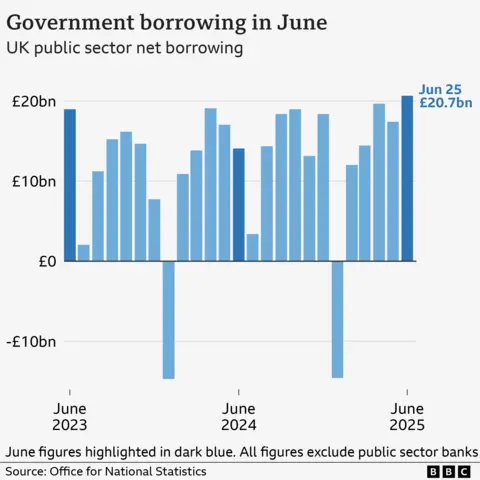
Borrowing – the difference between public spending and tax income – was £20.7bn in June, up £6.6bn from the same month last year, the Office for National Statistics (ONS) said.
Higher spending on public services and debt interest payments outstripped revenue from other taxes, including employers’ National Insurance contributions which was lifted in April, the ONS said.
Analysts say it is increasingly likely that the chancellor will have to raise taxes at the Budget in the autumn, after the government reversed cuts to benefits that had been aimed at saving billions of pounds.
The latest borrowing figure was the second-highest June figure since monthly records began in 1993, the ONS added, behind only June 2020, which was heavily affected by the pandemic.
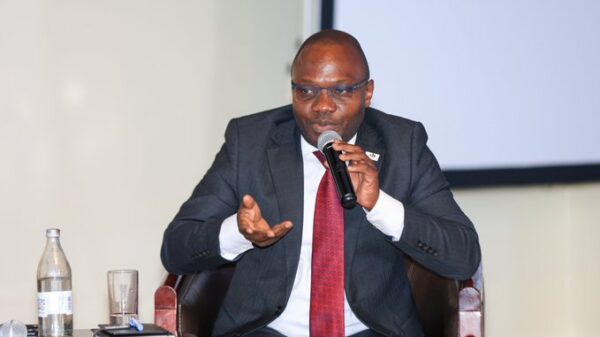
Dennis Tatarkov, senior economist at KPMG UK, said the data “piles more pressure on public finances”.
“Furthermore, the longer-term outlook for public finances remains difficult. Recent U-turns on welfare and persistent growth headwinds could open a gap against fiscal targets, which could require further tax rises or spending cuts in the Autumn Budget.”
The ONS said interest payments on government debt rose to £16.4bn in June 2025, which was nearly double the amount paid at the same point last year.
The increase is due to a pick-up in the rate of inflation, with interest payments on some government debt linked to the Retail Prices Index measure of inflation.
Borrowing in the first three months of the current financial year has now reached £57.8bn. While this is an increase of £7.5bn from the same period in 2024, it is in line with what the Office for Budget Responsibility, the official independent forecaster, had predicted.
Despite this, Alex Kerr, UK economist at Capital Economics, warned that “things will probably get worse for the chancellor”.
“We think that she will need to raise £15-25bn at the Budget later this year, with higher taxes doing most of the heavy lifting.”
Expectations are increasing that Reeves will have to raise taxes in the autumn in order for the government to fund its spending commitments, and last month she refused to rule out tax increases.
There has been speculation that the freeze on income tax thresholds, which is due to end in 2028, could be extended. The freeze means that, over time, more people are dragged into paying higher tax rates.
The chancellor is following two main rules for government finances, which she has argued will bring stability to the UK economy:
- day-to-day government costs will be paid for by tax income, rather than borrowing
- to get debt falling as a share of national income by the end of this parliament in 2029-30
Mr Kerr said the latest borrowing figures showed income tax revenue had been lower than expected “which suggests that the recent weakness in the labour market is weighing on receipts”, and this could continue “with underlying economic growth still weak”.
The most recent growth figures have shown that the UK’s economy contracted in both April and May.
Reacting to the latest borrowing figures, Darren Jones, Chief Secretary to the Treasury, said: “We are committed to tough fiscal rules, so we do not borrow for day-to-day spending and get debt down as a share of our economy.”
Shadow chancellor Mel Stride said: “Rachel Reeves is spending money she doesn’t have. Debt interest already costs taxpayers £100bn a year – almost double the defence budget.”
By BBC