


























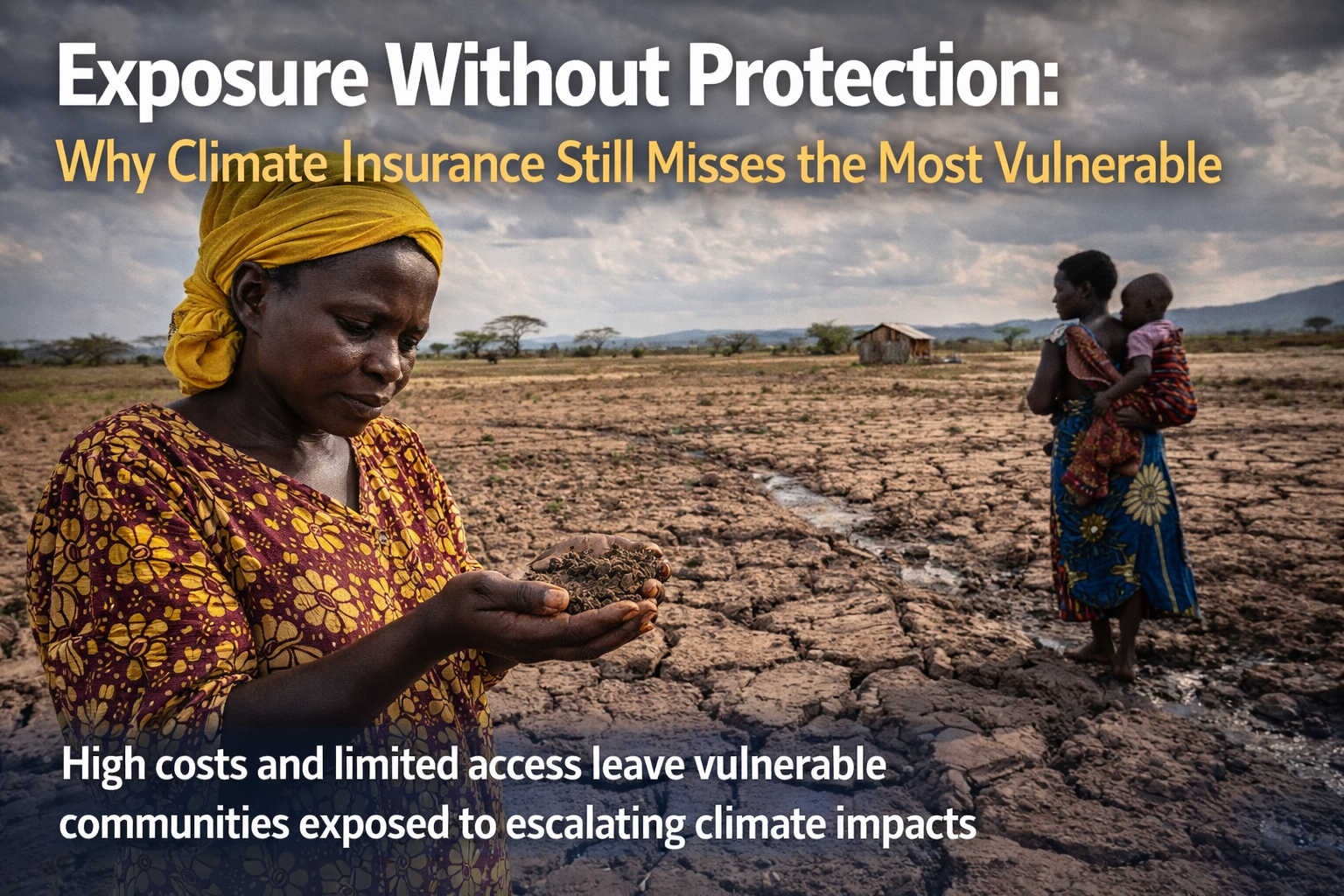

NAIROBI, Kenya, Feb 17 – Climate change is steadily reshaping Kenya’s economic risk landscape.
Droughts, floods, erratic rainfall, heat stress and shifting seasonal patterns are no longer episodic shocks; they are recurring disruptions that damage property, erode savings, destabilise small enterprises and threaten agricultural productivity.
The financial logic of insurance pooling risk to absorb loss should make climate coverage indispensable.
Yet in Kenya, and particularly among vulnerable and informal populations, uptake remains persistently low.
The contradiction is stark. Exposure is rising. Protection is not keeping pace.
A Slow but Growing Market -With Limits
Data from the Insurance Regulatory Authority shows that Kenya’s insurance penetration remains at approximately 2.3 to 2.4 percent of GDP,far below the global average of about 7 percent.
While total industry assets have grown, surpassing Sh1 trillion in recent reporting periods, this growth has not translated into proportionate expansion in policy uptake among households and small enterprises.
Agricultural and climate-linked insurance products;which are most relevant in the context of climate volatility account for less than one percent of total premiums.
This is particularly concerning in an economy where agriculture contributes significantly to GDP and where informal enterprises form the backbone of urban livelihoods.
The market is expanding in value, but not necessarily in reach.
The protection gap is not merely a statistic.
It represents millions of Kenyans who remain financially exposed to climate shocks without a buffer.
Regulator Pushes Innovation-But What About Inclusion?
The Insurance Regulatory Authority has intensified its push for broader insurance access.
Through digital transformation oversight, consumer protection frameworks and support for microinsurance regulation, the regulator has sought to encourage innovation while safeguarding policyholders.
IRA’s leadership has repeatedly urged insurers to design products that resonate with ordinary citizens and to leverage distribution channels such as bancassurance and digital platforms to penetrate underserved markets.
Microinsurance, in particular, has shown growth momentum.
Recent data indicates that microinsurers have recorded significant increases in premium collection, suggesting appetite for affordable products tailored to lower-income segments.
Yet regulatory ambition confronts market realities.
Climate risk products require sophisticated modelling, reliable weather data and reinsurance backing all of which increase costs.
As climate events intensify, insurers must balance inclusion goals with solvency requirements and capital adequacy thresholds.
The regulator’s strategy reflects an awareness of this tension: inclusion must expand, but not at the expense of systemic stability.
Major insurers are increasingly acknowledging climate risk as a material business concern.
CIC Insurance Group, in its latest sustainability disclosures underpinning its 2025–2030 roadmap, states:
“We have undertaken an assessment of climate-related financial risks and opportunities.Recognizing the increasing materiality of climate-related issues, we have prioritized both physical and transition risks that may affect our financial performance, strategic planning and overall business resilience.”
This language signals that climate risk has moved from corporate social responsibility rhetoric into financial governance.
CIC further reports rising microinsurance penetration within its portfolio and highlights its adoption of IFRS S1 and S2 climate disclosure standards positioning itself within global sustainability reporting frameworks.
Group CEO Patrick Nyaga adds, “Our sustainability strategy is deeply rooted in the cooperative values that shape who we are as an organization.Our solutions are therefore geared towards innovating products that address emerging risks such as climate change and tailoring them to fit the needs of different audiences.”
Similarly, ICEA LION General Insurance Company identifies physical climate risks including extreme weather variability as material to underwriting performance and long-term capital planning, while ZEP-RE (PTA Reinsurance Company) has warned of escalating catastrophe claims across the continent, reinforcing the role of reinsurance in absorbing systemic shocks.
Continental reinsurer Africa Re has been particularly blunt about the scale of the gap.
Speaking during the Africa Reinsurance Climate and Insurance Workshop, Phocas Nyandwi, Regional Director at Africa Re, said Africa contributes barely 2 percent of global agricultural insurance premiums, despite agriculture accounting for about 30 percent of Sub-Saharan Africa’s GDP.
“Fewer than 17 percent of farmers are insured, highlighting the already low penetration,” Nyandwi said.
“This exposes farmers to shocks such as climate change. Very few people understand what agricultural insurance entails and how it can protect them from various climate risks. There’s also the issue of affordability most farmers cannot afford the premiums,” he added.
Isaac Magina, Agriculture and Climate Insurance Lead at Africa Re, said more investment is needed to strengthen the capacity of underwriters to manage climate-related risks.
“We have seen a spike in climate-related events that expose farmers to shocks such as droughts and floods. We want people to be aware and take action,” Magina said.
“Climate insurance is still a relatively new concept, and most underwriters are in the formative stages. To insure climate risks, one needs to leverage many parameters, and most of our underwriters don’t yet have these capabilities.”
The candid acknowledgement from reinsurers underscores a systemic challenge: climate insurance is technically complex, capital-intensive and still maturing.
The Accountability Question: Inclusion vs Profit
At the same time, IRA data shows rising claims and increasing operational costs within the sector.
Claims payouts have surged in recent reporting periods, reflecting both medical and catastrophe-related exposures.
When claims grow faster than premiums, profitability narrows, prompting insurers to prioritise safer, higher-margin lines such as motor and health coverage over climate-exposed portfolios.
Commission expenses and aggressive competition for market share further strain underwriting margins.
In such an environment, expanding into high-risk, low-income segments may appear commercially unattractive unless supported by subsidies, reinsurance buffers or public-private partnerships.
This creates a fundamental accountability dilemma.
Sustainability reports emphasise ESG integration, climate governance and inclusive innovation.
Yet balance sheets and shareholder expectations impose discipline.
The result is a cautious expansion of microinsurance and agricultural cover, rather than transformative scale.
Climate insurance, then, sits at the intersection of corporate responsibility and commercial reality.
Bridging the Gap Between Strategy and Protection
The industry’s own disclosures reveal awareness.
Regulators are pushing innovation. Reinsurers acknowledge capacity gaps.
Microinsurance is growing incrementally. Yet penetration remains shallow, and climate-linked products still represent a marginal slice of the overall insurance market.
The challenge is no longer conceptual. It is structural.
Climate risk is accelerating. Informal enterprises and smallholder farmers remain financially exposed.
And while insurers increasingly speak the language of resilience and sustainability, meaningful protection for the most vulnerable segments will depend on deeper underwriting capacity, affordable pricing structures, digital distribution channels and stronger public-private collaboration.
Until then, climate insurance in Kenya will remain a strategic ambition discussed in sustainability reports but not yet a universal safety net for those most exposed to an increasingly volatile climate.