















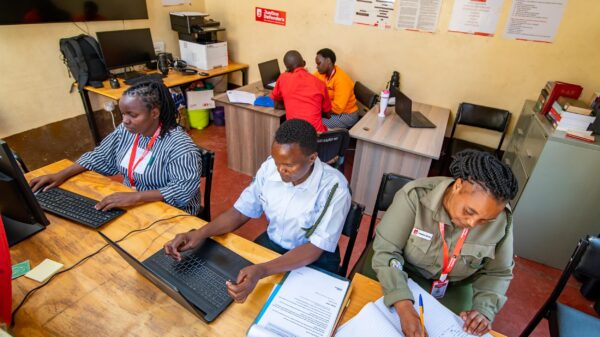


Kenya’s education ministry has proposed that information and communication technology (ICT) – such as computers, laptops, tablets, and cameras – be used to help teach certain subjects and improve how students learn. The technology can, for instance, stimulate creativity, help children understand complex topics and give them tools to learn more independently.

In 2011 the ministry created an integration team to coordinate and harmonise all initiatives. The team worked with a Flemish and Belgian non-profit organization – VVOB (education for development) – dedicated to improving the quality of education in developing countries.
Part of the plan included a professional development program that was carried out in four pilot schools and lasted two years. It was designed to help teachers learn how to integrate technology into the curriculum. Because teachers are in control of the classroom settings, it was crucial that they were part of this collaborative experience.
My colleagues and I evaluated the program. Our main focus was on how many teachers continued to use technology in their lessons after the program ended in the four government-funded secondary schools. None of these schools had previous experience with ICT.
We found that teachers faced a wide range of challenges when it came to integrating technology into their classrooms. These included a lack of electricity, infrastructure, and connectivity. Moreover, the training needed was complex and the resources required to deliver it were scarce.
At the start of the intervention, teachers didn’t know how to integrate technology into their classes. They also didn’t have enough time to develop new lessons and had too many pupils to teach.
Our findings support the view that integrating technology into schools doesn’t automatically follow a simple placement of hardware and software. It involves understanding the dynamic relationship between technology, how it’s used in the classroom and the content of the curriculum.
Our research also suggests that the professional development of teachers is a long term project. It needs constant reiterations of learning about emerging technologies and how to use them. This must be in balance with the national ICT initiative but also, more importantly, be sensitive to the different school cultures and communities.
Integration is key
In the schools we evaluated, technology training sessions were developed under a professional development program. These were designed to encourage teachers to identify challenging areas in their teaching and then brainstorm about how technology could offer an advantage in the classroom. For instance, how technology could help them overcome the challenge of scarce or outdated textbooks. Trainers in the workshop would then train the teachers in teacher design teams on the skills they would need to accomplish the task.
We conducted teacher questionnaires and focus group discussions with a total of 64 teachers. The aim was to see how many teachers used technology in their classrooms two years after the program had ended. Based on the results it appeared that some teachers were just beginning to use technology to present information. But most were using it to support their educational practice outside the classroom. For example, they used technology to prepare lessons or to email with colleagues.
This was due to a number of challenges, including:
1.Schools kept hardware, like computers, in labs. This physical separation of technology and the actual classroom meant that it was harder to integrate technology in learning activities. But labs were used because of poor security, power breakdowns and a lack of space in the classrooms.
2. At the beginning of the project, the schools didn’t have clear goals on how to support technology integration after the professional development program. This could be because a large number of people – from the principal to integration teams – were involved in decision-making processes. Also, participants only felt more clear about the role of ICT in education towards the end of the program.
3. The teachers also needed additional support from administrative school leaders, like the headteachers. These leaders would have the authority to demand the installation of electricity and connectivity in each class. But in one school, the teachers said that they didn’t feel they had support from the leadership or good direction.
We also found positive outcomes.
For example, there was collaboration at the school as well as the regional level. In some schools, the teachers worked with others in different schools and passed on ideas. In turn, this contributed to the promotion of professionalism.
We concluded that the gains of the program could only be sustained if schools and teachers felt a sense of ownership and were part of a process of evaluation so that they could understand what they’d learned, and what goals they wanted to set. This stresses the importance of professional development as a permanent process, aimed at extending and updating the professional knowledge of teachers in the context of their work.
Jo Tondeur, Assistant Professor, Vrije Universiteit Brussel
This article is republished from The Conversation under a Creative Commons license. Read the original article.