

















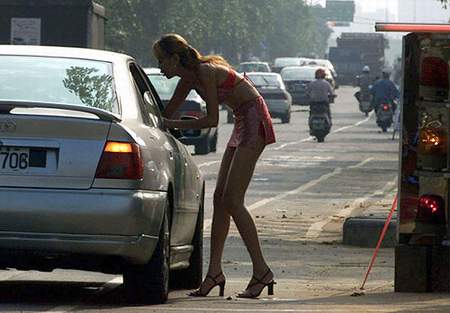

Walking down Mamlaka Road, I come across students clad in sexy and seductive attire chirping and chanting lively. Strutting stiletto heels and leaving cheap but a strong fragrance of perfume in their path, one would be mistaken to think a Uni beauty has taken the streets as the runway.
I move swiftly and engage one of the ladies in a conversation.
“What’s the plan today?” I ask naively.
“Come on, it’s a Friday, we are going to look for money. We are chilling for a taxi to take drop us in Westy,” she replies. Westlands is probably the most turntup and ratchet zone at night. ’
I am momentarily bemused by five students. The oldest is 23 years while the youngest is 21 years old. As we talk further, they tell me that they are already booked by their ‘friends’ who lavishly spend on them, some as old as 60 years.
‘’Life is money, and to survive on campus, we need this money. Old Men are willing to spend on us for sex,” Mary boldly says, without any whiff of shame.
This is just one of the character traits exuded by the Millennial Generation or Generation Y. Researchers and commentators argue that this group – people born in late 1980s and early 2000s – are the fastest ever changing generation.
William Strauss and Neil Howe, the authors of The History of America’s Future 1584-2069, argued that it’s a generation characterized by creativity, strong sense of community, both local and global. Jean Twenge, the author of Generation me, argues that Generation Y is characterized by confidence and tolerance, but with a sense of narcissism. But what is the future of Kenya’s generation Y?
On a Saturday evening, I meet Mercy*, a student studying Bachelor of Arts at the University of Nairobi. She is pregnant, she tells me.
“I don’t know the father of this baby, I slept with two men that I met at a friend’s party, I was drunk. I don’t know what to do”, she says.
Asked whether she has told her parents about it, she reveals that she is afraid, and she can’t even think of an ‘abortion’
Generation Y has been described as the ‘facebook generation’ relying heavily on social media as the main means of communication, which has led to erosion of morality. Beatrice Kanga, while writing This is Sierra Leone, says that Kenya’s Facebook generation is guilty as charged.
“While they are indulging in every form of fun, are they making sure that these things won’t haunt them?” she asks.
In Kahawa West, I meet 10 Kenyatta University students in a room, others more drunk than the others. Kamau, who looks a bit strong, offers to talk to me.
“We are having a time of our life, if we can’t enjoy life right now, we won’t be able to have such moments when we grow up,” he says.