Eating fish linked to longer life: US study

eat fish live longer

People age 65 and older who eat fish may live an average of two years longer than people who do not consume the omega-3 fatty acids found mainly in seafood, a US study suggested on Monday.

People with higher levels of omega-3 fatty acids also had an overall risk of dying that was 27 percent lower, and a risk of dying from heart disease that was 35 percent lower than counterparts who had lower blood levels, said the study.

The research was led by scientists at the Harvard School of Public Health and was published in the Annals of Internal Medicine.

While other studies have demonstrated a link between omega-3 fatty acids and lower risk of heart disease, this research examined records of older people to determine any link between fish-eating and death risk.

Researchers scanned 16 years of data on about 2,700 US adults aged 65 or older. Those considered for the study were not taking fish oil supplements, to eliminate any confusion over the use of supplements or dietary differences.

Those with the highest blood levels of omega-3 fatty acids found mainly in fish like salmon, tuna, halibut, sardines, herring and mackerel, had the lowest risk of dying from any cause, and lived an average of 2.2 years longer than those with low levels.

Researchers identified docosahexaenoic acid (DHA) as most strongly related to lower risk of coronary heart disease death.

Eicosapentaenoic acid (EPA) was strongly linked to lower risk of nonfatal heart attack, and docosapentaenoic acid (DPA) was most strongly associated with lower risk of dying from a stroke.

The findings persisted after researchers adjusted for demographic, lifestyle and diet factors.

“Our findings support the importance of adequate blood omega-3 levels for cardiovascular health, and suggest that later in life these benefits could actually extend the years of remaining life,” said lead author Dariush Mozaffarian, associate professor in the Department of Epidemiology at Harvard School of Public Health.

“The biggest bang-for-your-buck is for going from no intake to modest intake, or about two servings of fatty fish per week,” said Mozaffarian.

In Japan, would-be sushi chefs suffer for their art

making sushi1

“Sometimes I cry, but only when I’m at home on my own,” says Tetsuya Sakurai, one of a select few who has paid $6,000 for an intensive — and stressful — training course to become a sushi chef in Tokyo.

To the untutored, a little ball of rice with a slice of raw fish on top may look like a simple affair.

But students on the twice-yearly course in the Japanese capital soon learn that for masters of the art, there is so much more to it than meets the eye.

“The best students will take at least two years before they can do this properly,” said teacher Kazuki Shimoyama. “The slowest may take four.”

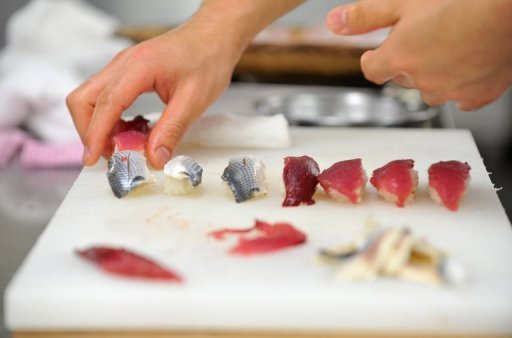
And before they even get to the stage where they are allowed to combine the delicately formed nigiri (rice balls) with a slice of sashimi, they have to learn how to cut the fish.

For Sakurai, hunched over a fresh mackerel as he slips the razor-sharp knife through its firm flesh, it’s a nerve-wracking experience, made all the worse by the presence of three glowering teachers, watching his every move.

“It’s very hard,” he tells AFP, a month into his course. “I train at school every day. Cutting the fish is like performing surgery. But what I really don’t enjoy is removing the innards from a shellfish. It’s really difficult.”

Like his fellow students, Sakurai eagerly answers when their tutor asks if they understand.

“To cut the fillet lengthways, pull the tail and slide the knife along. You follow?” bellows the teacher. “Yes!” the 20 shout in unison.

“Then cut each piece diagonally, making the tail end a little bigger. You follow?”

“Yes!” they reply again.

But Sakurai has not pleased his mentor this time.

making sushi2

“That’s your attempt at cutting a mackerel? Terrible. Do it again,” he is told.

Students work in silence in a classroom where harsh neon lights glint off steel knives, threatening to expose the tiniest imperfection on the bleach-white clothes they wear.

Sushi rice — perfectly plump Japanese shortgrain into which precisely measured quantities of rice vinegar, salt and sugar are folded — is pressed into a large pellet in the hands.

Too much rice and it will be more than a mouthful; too little and it will be overpowered by the fish; too much pressure and it will be hard; too little and the pellet will fall apart.

A delicate smear of wasabi — a fiery green root that is grated into a paste — is applied to the rice and a sliver of fish is placed on top.

“It sounds easy, but it’s really hard to make them the way they are supposed to be,” admits a student who gave his surname as Yamanaka. “The teacher makes it look so easy, but it’s really difficult.”

If they complete the three-month course, run by the restaurant chain Sushi Zanmai — whose boss paid a record $1.8 million for a single fish in the first auction of the year at Tsukiji market — students will receive a level 5 diploma.

making sushi3

Two years’ hard graft in a restaurant and they get their level 4.

Reaching level 1 can take years.

For Sakurai, who spent two decades working as an accountant in the US and in England, the sushi school has been something of a culture shock.

“My teacher is a bit aggressive, it’s almost military,” he says.

“It’s so different from what you might expect in a Western education system where they praise you when you do something well.”

Here, not being shouted at is the only indication students get that they are making the grade.

“I have two more months,” says Sakurai. “After school I practise in the evenings at home, especially cutting some of the shellfish. I cannot do it at all, but I’ll get there.”

“There” for Sakurai, is his own sushi bar “in Asia, in Japan, maybe in France. Why not?” he muses.

For teacher Shimoyama, making sushi properly is not supposed to be easy. It’s a vocation, something into which a chef pours his whole heart again and again.

“Chefs gain speed and should strive to achieve the best possible sushi. They should give it their body and soul. And no matter what, they should always smile for customers.”

And even when the diplomas are finished and a chef has his own place, his own regular customers, there is still more he can do to perfect his art.

“I have made sushi for 29 years,” said Shimoyama. “And I am still learning.”

VIDEO: Croc waits for struggling Wildebeest


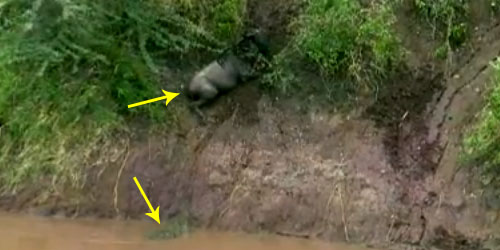
The harsh laws of nature dictate that only the fittest survive. With humans, this mostly applies to mental and physical strength combined. In animal-speak however, it could mean that a weak Wildebeest could not make it up the steep bank across the river as down below the strong jaws of a crocodile waited.

Such was the case when Capital Business reporter Nderitu Ndegwa and Videographer Muthoni Njuki went to witness the wildebeest migration.

After grabbing the struggling Wildebeest that slipped back into the water severally, the crocodile proceeded to quickly drown it in water before making a meal out of it. Take a look below.